

We are changing how we manage network reinforcements. we are making it easier, fairer and more efficient to connect biomethane to our network.
We are launching our new Assessment Windows that cluster projects, share reinforcement costs and provide developers with a clear and the most cost-efficient reinforcement solution.
Applications for the first assessment window are now closed. We will update this page with updated timelines in line with the launch of our second assessment window. For further information please get in touch.
We hope that below FAQs provides the context and information you need, but if you have any additional questions, please get in touch.
We’re changing how we manage network reinforcements to make it easier, fairer, and more efficient to connect biomethane to our network.
We are launching new Assessment Windows that can support both clusters of projects and standalone projects. Where projects are assessed together, reinforcement costs can be shared, helping developers access the most efficient reinforcement solution and maximise the benefit of the UIOLI funding made available by Ofgem to support network reinforcement activities.
These changes are underpinned by Ofgem-backed charging rules, which reduces the contribution any single developer pays toward reinforcement.
Developers can join Assessment Windows for both standalone projects and projects that may benefit from being assessed alongside others. Once we have all of the applications submitted for consideration, we will collate and conduct network analysis to identify the most efficent reinforcement solution. This can enable shared reinforcement and lower costs where appropriate.
Our aim is to lower barriers to entry with a structured, transparent, and consistent process across all regions.
Ofgem’s RIIO-3 Final Determination allocated Cadent £80 million of regulated funding to support network reinforcement for biomethane connections. Eligible individual projects may receive up to £2 million toward reinforcement costs.
The funding was initially divided equally across Cadent’s four regulatory networks (£20 million each). We have since worked with Ofgem to remove these regional restrictions, making the full £80 million available according to demand across our networks.
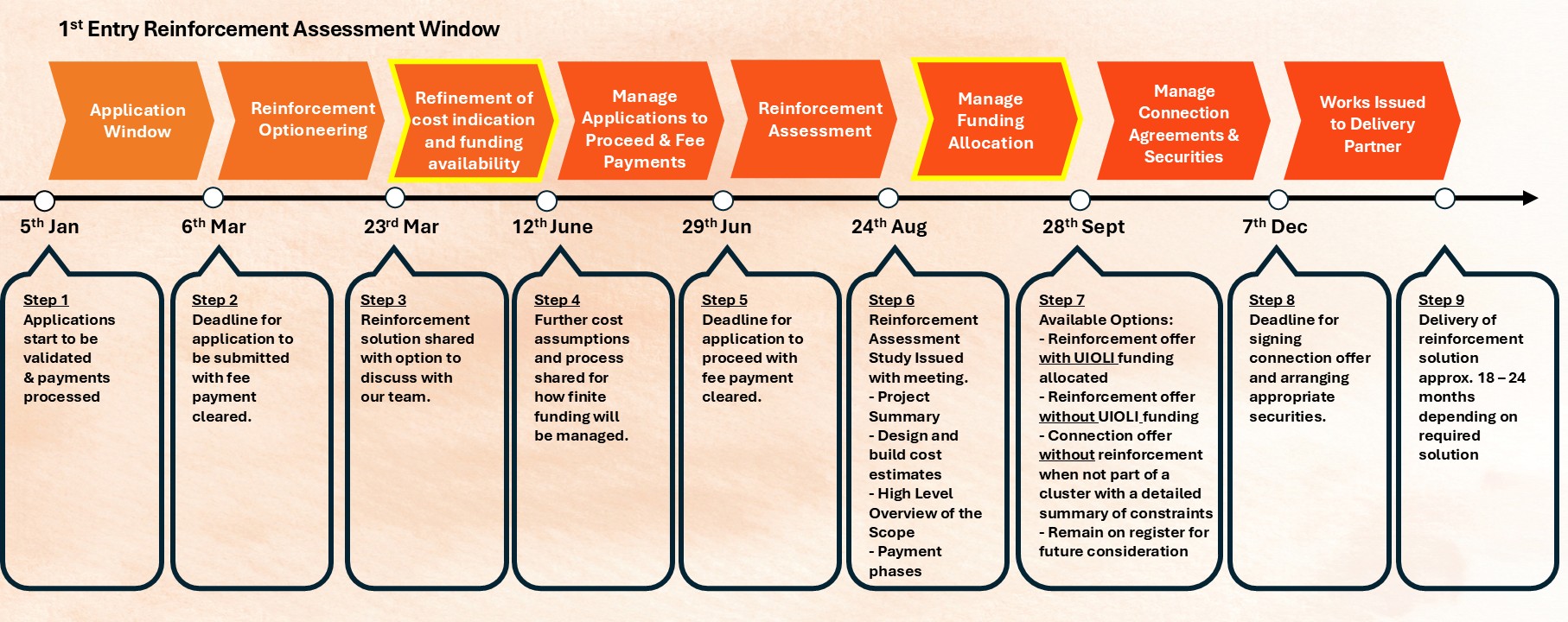
We will be keeping customers updated throughout the new process with clear milestones and steps outlined from the start. In advance of the application window we will provide further guidance documentation relating to each stage of the entry reinforcement process. Following the Initial Optioneering Assessment, we will inform customers of which reinforcement option will be taken forward to a Reinforcement Assessment Study, and an indicative cost will be provided. On completion of the Reinforcement Assessment Study, a Connection Offer and Reinforcement Offer will be made alongside new updated contract agreements.
Cadent’s charging proposals will align with Ofgem’s guidance on funding for biomethane reinforcements. Where there is funding still available from Cadent’s allocated amount, eligible projects will be allocated up to £2m off the Capex costs of the reinforcement, and these costs will be socialised across gas consumers. The remaining Capex costs will be payable by the customer, and ongoing Opex will be part of a maintenance agreement.
On completion of the reinforcement assessment, we will provide projects with cost estimates and the corresponding individual contribution.
Although the current window is closed, you can register your interest and we will contact you ahead of future Assessment Windows. To register your interest, please email your details to [email protected].
We expect the next Assessment Window to open in early 2027 and will provide advance notice and guidance ahead of its launch. This page will be updated with revised dates ahead of the opening of our second Assessment Window.
The initial fee for entering the reinforcement window is £1,667, excluding VAT. On completion of the Initial Optioneering Study, customers will be presented with a reinforcement solution, indicative cost and timescales. To proceed with the Reinforcement Assessment Study, a further £12,750, excluding VAT, will be due. On signing the reinforcement offer, these costs will be refunded against the contribution towards the reinforcement solution.
You will be registering your interest for entry reinforcement. The £1,667 (excluding VAT) fee covers participation in the Assessment Window and the analysis required to determine the most appropriate reinforcement solution for your project, whether that is a standalone solution or a clustered solution with other projects. Where a clustered solution is identified, you may also benefit from cost sharing.
We will identify the least cost, fit for purpose reinforcement solution for your project, and undertake a Reinforcement Assessment Study for that solution if you wish to proceed at a cost of £12,750 (excluding VAT). At the end of that process you will be provided a connection offer and a reinforcement offer for your requested capacity on a constant flow rate.
A cluster is defined as a group of customers, who wish to connect the same geographic area of the network, and who would jointly benefit from additional entry capacity created by a shared reinforcement.
Yes. Our charging proposals include the provision for existing projects to apply for a reinforced connection to improve their year-round output or to increase their peak capacity.
Following your application submission and receipt of payment, our engineering teams will carry out an Initial Optioneering Assessment and identify the most appropriate reinforcement solution for your project.
Following this process, we will share the assessment outcome and discuss the findings with you. The identified reinforcement option will then go through an internal sanctioning process to ensure it is the most effective, economic and efficient solution.
Where a project is eligible for Biomethane Use It or Lose It (UIOLI) funding, the scheme can be used to support the costs associated with network reinforcement required to facilitate a new biomethane connection or increase capacity at an existing biomethane connection. This may include both operational and capital expenditure relating to reinforcement activities such as pipelines, compressors, pressure management and storage infrastructure. Funding is subject to the requirements and eligibility criteria set out in Ofgem's Biomethane UIOLI Governance Document. https://www.ofgem.gov.uk/sites/default/files/2026-08/Biomethane-UIOLI-Governance-Document.pdf
The outcome of the assessment will confirm whether your project is eligible for UIOLI funding support, the reinforcement solution identified, indicative costs and associated delivery timescales.
This will be managed appropriately as part of the Assessment Window and reinforcement solutions outcome review. We will initially identify the reinforcement options required to meet all customers’ needs that have applied in that window. Where necessary, we will determine what is required without the customer that has chosen not to progress and discuss with remaining cluster partners any changes to the required reinforcement. The reinforcement solution and associated costs will be re-evaluated.
If you decide not to progress before the connection offer is signed and your project forms part of a cluster, the remaining projects in that cluster will be reassessed to determine whether the clustered solution remains viable and whether costs or outcomes are affected. For standalone projects, your withdrawal is unlikely to impact other projects within the Assessment Window. You will also have the option to be placed on a register should you wish for us to contact you about future Assessment Windows or potential clustering opportunities in this location.
The purpose of the register is to express interest in a future reinforcement window. This could be due to your project not yet being ready to proceed in time for the current window, or where today the cost of reinforcement is still unviable, and there is interest in waiting for future projects to join the cluster, which could bring that cost down.
No. If you have paid the application fee but decide not to proceed at that time, you can request to remain on our register for future opportunities. We will proactively contact you if a future Assessment Window, standalone reinforcement solution, or potential clustering opportunity arises that may be relevant to your project. However, inclusion on the register does not guarantee that a future funding, clustering, or reinforcement opportunity will become available, or that your project will be selected for any future assessment.
We have completed standard design work for packaged reverse-flow compressors and engaged the market to identify the most suitable solutions to help ensure that build costs are kept to a minimum.
During the feasibility stage, Cadent will provide best-case and worst-case reinforcement cost estimates; for example, where all projects within a cluster contribute to the reinforcement costs versus your project bearing the costs alone.
Cadent will demonstrate that any funding is being spent efficiently and, therefore, will pursue the lowest-cost, fit for purpose solutions while also exploring innovative and alternative approaches where appropriate.
At this stage, the selected reinforcement option will be taken forward with our delivery team to carry out a Reinforcement Assessment Study. This will provide an updated cost estimate with greater confidence and set out a timeline. It will consider such aspects as lead times for key materials, construction time and will include an assessment of the proposed site/s
A connecting party will be liable for 100% of any stranded reinforcement cost if they are unable to complete their project as planned. Additionally, customers that do not flow at their requested rates within the first two-years post-reinforcement commissioning may be liable for stranding costs, and Cadent will be able to draw upon the financial security provided. We have proposed arrangements to Ofgem that require all parties with reinforcement offers that utilise UIOLI to provide financial securities. Still subject to an Ofgem decision, our proposal is for the amount of required financial security to be set at a level equivalent to 50% of a customer's UIOLI allocation. Our Connections Charging Methodology and Statement of Connections Charges will outline the acceptable forms of financial security once published, and will be linked to a customer's credit rating.
Cadent may accept:
Still subject to an Ofgem decision - Our Connections Charging Methodology and Statement of Connections Charges will outline the acceptable forms of financial security once published, and will be linked to a customer's credit rating.
Security remains in place until the customer has demonstrated sustained output at contracted network entry capacity. This is measured across three separate 24-hour periods within a specified tolerance and separated by at least 28 days.
We will build the reinforcement to total capacity need and therefore will not be prioritising sites in a cluster. We anticipate varied gas to grid dates and will aim for the reinforcement to be ready for the first entry connection depending on the timeline of the plant build. Anyone applying in a later cluster may have to wait for the reinforcements to be completed for earlier clusters, if they interact.
This will be in line with the Cadent Privacy Policy.
Any developer benefitting from a reinforcement solution will be required to pay a proportion based on peak entry capacities.
For already connected sites if they require reinforcement to flow above the current connection offer, they will need to come into the reinforcement process as applicable.
Additionally, Cadent will design reinforcement solutions to provide entry capacity at a level to meet the known requirements of developers that have applied within an application window. This limits the risk of parties benefitting from created capacity without participation in an application window without making financial contributions to the reinforcement.
We have developed the new process through ongoing engagement with our community of biomethane producers, and at our London event in September 2025 we gathered vital feedback which we have assessed and embedded into our process. We recognise the importance of co-creation to ensure the process is suitable for the UK biomethane industry. We will also be constantly keeping our processes under review, bringing forward changes where necessary.
As part of the enhanced customer journey, we are working to improve the post commission aftercare service we provide and value your feedback in this area. Where a reinforcement solution has been delivered, we will establish protocols to communicate and coordinate outages to minimise any detrimental impact on the capacity availability. As with our connection offer today, 30 days’ notice will be given of any planned work needed to be undertaken.
Cadent is not directly responsible for administering or assessing applications to the Green Gas Support Scheme (GGSS). The application process and eligibility requirements are managed by Ofgem.
Cadent is actively supporting discussions at a regulatory and industry level to highlight the current issues, the demand for green gas connections, and the ongoing review of GGSS funding arrangements. Our objective is to ensure that the impacts on developers and the wider biomethane industry are understood and considered by the relevant stakeholders.
Please refer to thir website for further information: https://www.ofgem.gov.uk/environmental-and-social-schemes/green-gas-support-scheme-and-green-gas-levy/applicants.
 (1).png)